4 Seamless Floral Patterns: Integrating Vector Assets into Professional Design Workflows
In the landscape of digital asset creation, the distinction between a static image and a reusable pattern is critical for efficiency. 4 Seamless Floral Patterns represents a specific category of vector-based design resources that bridge the gap between artistic illustration and technical scalability. These assets are not merely decorative; they are functional components designed to be tiled infinitely without visible seams, making them indispensable for surface pattern design, textile printing, and large-format background generation.
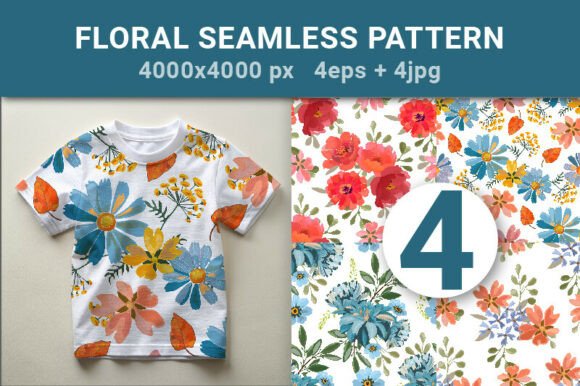
The collection described here—comprising four distinct floral motifs rendered in a watercolor style on a white background—offers a blend of organic aesthetic appeal and rigid technical precision. For professionals ranging from freelance graphic designers to small business owners producing branded merchandise, understanding how to integrate these assets into existing workflows can significantly reduce production time while maintaining high visual quality. This article explores the practical application, technical specifications, and strategic implementation of these vector floral patterns.
Understanding the Asset Structure
To utilize 4 Seamless Floral Patterns effectively, one must first understand the dual nature of the file package provided. The inclusion of both EPS 10 vector files and high-resolution JPG raster files caters to different stages of the design process and varying software capabilities. This hybrid approach ensures compatibility across diverse professional environments.
- EPS 10 Vector Files: These are the core assets for scalable design. Being vector-based, they allow for infinite resizing without pixelation. This is crucial when moving from a standard business card template to a full-scale wallpaper or fabric roll. The EPS 10 format is widely compatible with Adobe Illustrator, CorelDRAW, and Inkscape, ensuring that the integrity of the watercolor effect is maintained through path data rather than fixed pixels.
- JPG Raster Files (4000x4000 px): While vectors offer scalability, there are instances where immediate visual feedback or integration into raster-heavy workflows is necessary. The 4000x4000 pixel resolution provides sufficient detail for most web and print applications up to A3 size at 300 DPI. Importing these directly into Photoshop allows for rapid prototyping before committing to vector editing.
This duality supports a flexible workflow. A designer might begin with the JPGs in Photoshop to test color palettes and composition, then switch to the EPS files in Illustrator for final vectorization and precise tiling adjustments. This iterative process reduces errors and enhances creative control.
Technical Implementation and Compatibility
The transition from concept to final product requires careful attention to file handling. When importing the 4 Seamless Floral Patterns into Adobe Illustrator, users should ensure that the "Create Clipping Mask" option is utilized correctly if the pattern is intended for use within specific boundaries. Furthermore, understanding the tile dimensions is essential. Although the JPGs are square (4000x4000 px), the seamless nature means the edges must align perfectly. Most modern design software handles this automatically via the Pattern Edit mode, but manual verification is recommended to prevent subtle misalignments that become apparent upon close inspection.
For those working in non-vector environments, such as Canva or basic photo editors, the JPG files serve as the primary resource. However, it is important to note that scaling raster images beyond their native resolution will result in quality loss. Therefore, the recommendation is to use the JPGs for initial layout and mockups, reserving the EPS files for any project requiring enlargement or precise cutting paths, such as laser engraving or vinyl decal production.
Compatibility extends beyond software. The white background of these floral illustrations offers significant versatility. It allows for easy layering over colored backgrounds, textured papers, or photographic elements. In a typical branding project, a designer might place the floral pattern over a soft pastel gradient to create a wedding invitation suite, or overlay it on a dark navy background for a corporate luxury brochure. The lack of a hard border facilitates blending modes like Multiply or Overlay, enabling seamless integration with other visual elements.
Strategic Use Cases Across Industries
The application of 4 Seamless Floral Patterns extends far beyond simple decoration. They are structural elements in various industries, each requiring a different approach to implementation.
Textile and Surface Design
For fashion designers and home decor entrepreneurs, seamless patterns are the foundation of repeat prints. The watercolor style adds an element of handcrafted authenticity, which is currently trending in sustainable and artisanal markets. When preparing these files for textile printing, ensure that the vector paths are fully expanded and that any transparency effects are flattened according to the printer’s specifications. The EPS files are ideal for this stage, allowing for precise control over scale and repetition.
Publishing and Editorial Design
Educators, bloggers, and publishers often require engaging visual breaks in long-form content. These floral patterns can be used as headers, footers, or page backgrounds for e-books, workbooks, and digital magazines. Because the vectors are scalable, the same asset can be used for a thumbnail image and a full-page spread without compromising quality. This consistency strengthens brand identity across multiple platforms.
Stationery and Greeting Cards
Small business owners in the stationery niche benefit greatly from pre-made seamless patterns. Instead of creating custom illustrations from scratch, entrepreneurs can license or purchase these assets to create unique products quickly. The watercolor aesthetic appeals to consumers looking for elegance and warmth. By combining the floral pattern with minimalist typography, creators can produce high-margin products such as wedding invitations, thank-you notes, and gift tags.
Workflow Integration and Efficiency Tips
Integrating 4 Seamless Floral Patterns into a daily workflow requires organization and foresight. Here are practical steps to maximize efficiency:
- Asset Management: Create a dedicated folder structure for your design assets. Separate the EPS and JPG files clearly. Label them with metadata indicating the color palette or dominant flower type to facilitate quick retrieval during busy projects.
- Template Creation: Develop master templates in Illustrator or Photoshop that incorporate the seamless pattern as a background layer. Lock this layer to prevent accidental edits. This allows you to focus on adding text, logos, or other focal points without worrying about the underlying pattern alignment.
- Color Variations: Use the vector nature of the EPS files to experiment with color schemes. If a client requests a blue theme instead of the original red, you can easily recolor the vector paths globally. This capability saves hours of manual editing compared to raster images.
- Quality Control: Always export a proof at actual size before finalizing. Zoom in to check for jagged edges or unintended gaps in the watercolor texture. Vector artifacts can sometimes appear when complex gradients are converted to paths.
Furthermore, consider the lifecycle of the asset. Unlike temporary social media graphics, seamless patterns have a longer shelf life. They can be repurposed for packaging, website banners, and even app interfaces. By treating these floral patterns as evergreen resources, you build a library of assets that compound in value over time.
Conclusion on Practical Application
The true value of 4 Seamless Floral Patterns lies not just in their aesthetic beauty but in their technical robustness and adaptability. For the modern creator, the ability to switch seamlessly between vector precision and raster flexibility is a key competitive advantage. Whether you are designing a single greeting card or a global textile line, these assets provide a reliable foundation that respects both artistic intent and technical constraints.
By adhering to best practices in file management, leveraging the strengths of both EPS and JPG formats, and applying the patterns strategically across various media, professionals can streamline their production processes. The result is a higher quality output delivered in less time, allowing more focus on innovation and client satisfaction. In an era where speed and consistency are paramount, integrating well-structured vector assets like these floral patterns is not just a design choice—it is a workflow imperative.